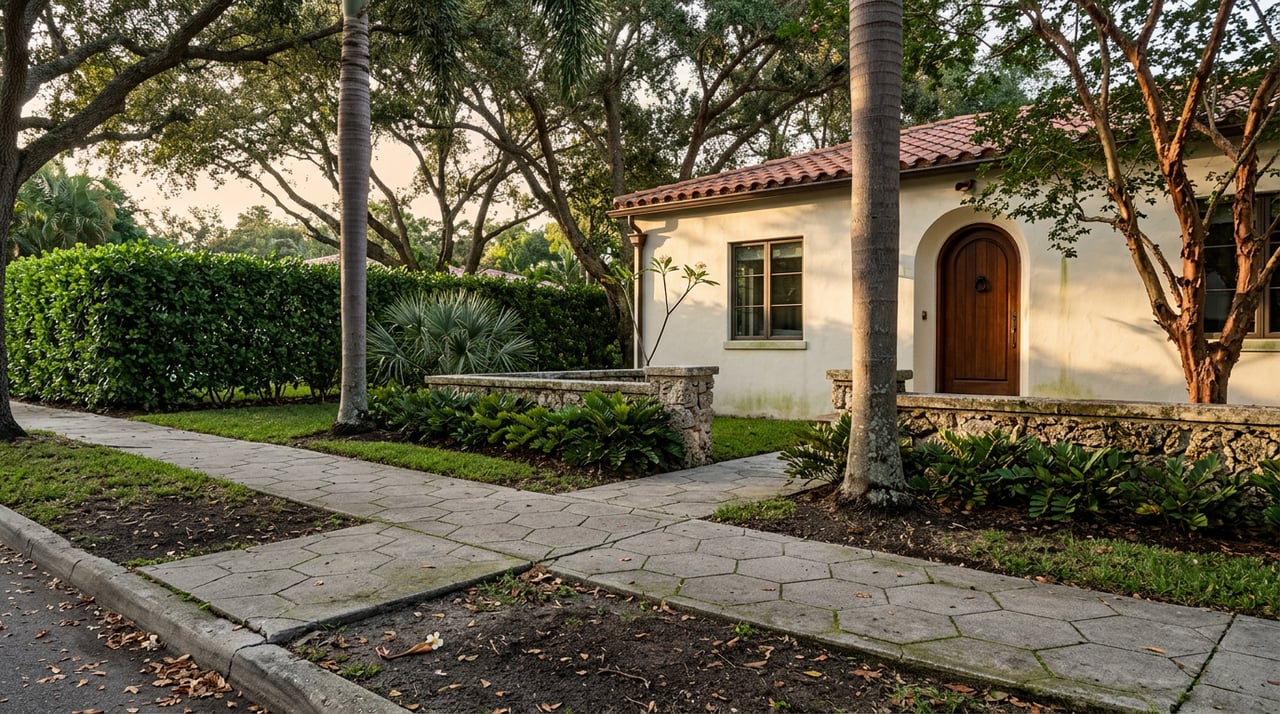
If you live in The Roads, you already know the shortcut that visitors never find. You know which of the diagonal avenues cuts to Coral Way without dumping you onto SW 12th, and you know that the quietest bench in the city sits about eleven minutes from your front door. What you may not have thought about is why any of that is true.
The answer is one decision made in January 1922, and a seven-acre patch of forest that has been standing here longer than the city around it. Everything worth doing on a Saturday in this neighborhood traces back to those two things.
The 45-degree decision that still shapes your weekend
Miami's grid is boring on purpose. Streets run east-west, avenues run north-south, and the numbering climbs in a predictable ladder. The Roads does none of that. The neighborhood was designed, platted and developed by Mary Brickell in January 1922, days before her death, and she rotated the whole plan roughly forty-five degrees off the county grid. The roads that run from Broadway to SW 32nd Road are roughly 45 degrees out of alignment with the grid-plan, the avenues running perpendicular to these roads are also 45 degrees out of alignment, and the avenues in this section run northeast to southwest rather than the standard north to south that the ones in the rest of the county follow.
This is not a trivia point. It is why the neighborhood feels like a neighborhood. The diagonal cuts break the sightlines that make every other Miami block feel like an arterial. Cars slow down at the odd-angle intersections because they have to. And the community was designed by Mary Brickell to be a pedestrian-friendly area with roundabouts, wide streets, and median parkways landscaped with native tropical plants. A hundred and four years later, those roundabouts are still doing their job. A neighborhood civic association has been reinforcing that work in the modern era, too: since 1986, the Miami Roads Neighborhood Civic Association has worked on a variety of projects to support the neighborhood.
If you moved here from a gridded part of town, that first month of getting lost was not you. It was Mary Brickell.
Simpson Park Hammock is the reason you should walk before breakfast
Ten minutes east of most Roads front doors, at 55 SW 17 Road, sits something the rest of Miami does not have. Simpson Park, officially Simpson Park Hammock, is a 7.8-acre urban park and nature preserve located between Brickell and The Roads, originally known as Jungle Park, as 5.5 acres were set aside in 1913 by a group of individuals to preserve what is now one of the last remaining tracts of Brickell Hammock, a tropical hardwood hammock which once ran from the Miami River to Coconut Grove.
Read that again. What is inside the fence is not a landscape architect's tribute to old Miami. It is old Miami. It is one of a handful of spots that has never been developed in Miami, and the rock ridge hammock is just as it would have been if you came with Julia Tuttle and the Brickells to Miami in the 1800s. Part of the natural area is old-growth forest and recognized by the Old-Growth Forest Network.
A few things worth knowing that most residents underuse:
- The plant census is real. With more than 160 plant species on view, including rare threatened and endangered plants, it is a park to explore on a sunny Miami afternoon. The canopy above the interior loop includes live oaks, strangler figs, Jamaica dogwoods, silver palms and gumbo limbo trees.
- The pavilion is worth looking at, not just walking past. The entrance structure was designed by Miami architect Chad Oppenheim with Swiss landscape designer Enzo Enea, part of the first phase of a public/private partnership to revitalize this historic park and return it to the community, with a pavilion that embraces and becomes interwoven within the diverse indigenous canopy of the hammock while minimizing ecological site impact.
- Guided walks happen. A June 6, 2026 program used Royal Poinciana trees and historic neighborhood landmarks to shape a guided walk through South Miami Avenue and Simpson Park. Similar naturalist-led walks are how longtime residents actually learn what they have been strolling past for years.
- The evening programming is quietly good. The city has run Hocus Pocus at Simpson Rockland Hammock Preserve Park on Oct 26 and Oct 27, 6 pm to 8:30 pm, a free experience. Put it on the October calendar now.
One practical note the map does not show you: the park is small and the hours are limited. The park is only open for limited hours, which is part of why longtime residents build their weekend around it rather than dropping in on impulse. Check the hours before you walk over.
The tables that hold the neighborhood together
The Roads is not a restaurant district, and residents will tell you that is the point. What it has instead is a short list of places that function like neighborhood living rooms. The Roads has an abundance of popular restaurants, including Honey Uninhibited and Tutto Pasta, and residents can spend free time outdoors at Triangle Park, take in local art at Galeria Adelmo, or charter a yacht from LUXE Charters.
Two things about that short list are worth pulling out.
First, Galeria Adelmo is not a passive gallery. Galeria Adelmo is a local gallery space that promotes local artists, offers classes for new artists and hosts private painting parties for small groups. If you have lived here for two years and never taken a class inside the neighborhood you actually live in, that is the low-hanging fruit of the year.
Second, Triangle Park is smaller than newcomers expect and better than they expect for that reason. Triangle Park is a small neighborhood park with a playground, picnic area and basketball court, and locals are welcome to bring their canine companions, as long as they keep them on a leash. It is not competing with the Underline or Kennedy Park. It is competing with your own back patio, and it wins on the mornings you want to see another human without committing to a conversation.
Groceries and everyday errands round out the map. Farm Stores Brickell is a grocery store, bakery and restaurant offering fresh produce in a convenient drive-thru format, and for other flavors, Oriental Bakery and Grocery sells specialty products and ready-made meals. Between those two and the market at Tutto Pasta, most Saturdays do not require crossing SW 12th at all.
A Saturday routed around the triangle
Here is how a resident who has lived here a decade actually spends a Saturday between October and May, when the mornings are cool enough to be outside before ten.
- 7:45 a.m. Coffee at home, then walk east on your diagonal avenue toward South Miami Avenue. The 45-degree plat means you are shaded by median parkway trees for most of the route.
- 8:15 a.m. Enter Simpson Park Hammock at the pavilion. Do the interior loop twice. On the second pass you start noticing the strangler figs you missed on the first.
- 9:15 a.m. Cut back west through the neighborhood and stop at Triangle Park if the dog is with you, or straight to Tutto Pasta's market side if it is a grocery day.
- 11:00 a.m. If it is a Galeria Adelmo class weekend, you are painting. If not, an hour of errands: Oriental Bakery for something ready-made, Farm Stores for produce.
- 7:30 p.m. Dinner at Honey Uninhibited or a pasta night at Tutto Pasta. Walk home. You have not driven a car since Friday.
The reason this works, and the reason it does not work in most Miami neighborhoods, is compression. The Roads is small on purpose. It is a triangular area located south of SW 11th Street, between SW 12th Avenue and SW 15th Road, just west of Brickell. Everything on that Saturday list sits inside those three sides.
Getting out without giving up the neighborhood
The other quiet advantage of living here shows up when you actually want to leave. The Roads neighborhood is served by the Miami Metrorail at the Vizcaya station to the south and by the Brickell station to the north. That means Government Center, the airport line, and a game at the arena are all reachable without moving your car out of the swale. Residents who have figured this out treat the two stations as bookends, walking to Brickell for a weekday lunch meeting and to Vizcaya for a Sunday at the museum grounds.
The trade-off, as anyone who has lived here through a summer knows, is that the tree canopy that makes The Roads feel like The Roads is also fragile. Simpson Park itself has felt this: in the park, powerful winds from Hurricane Irma caused extensive ecological disruption, heavily defoliating the tropical hardwood hammock canopy and toppling numerous mature trees, and the storm led to physical infrastructure damage, including breaches in the perimeter fencing and widespread blockages along its pathways, necessitating an immediate closure of the site that lasted several months. The canopy that shades your walk to the park is the same canopy that needs volunteer hours after every serious storm. If you have been meaning to plug into the civic association, that is the on-ramp.
The point
The Roads is not Brickell's quiet cousin, and it is not a stepping stone between two more famous places. It is a hundred-and-four-year-old off-grid experiment in walkable residential design, wrapped around one of the last pieces of the original Miami forest. The residents who get the most out of it are the ones who stop treating the triangle as a place to sleep and start treating it as ten blocks with a plan.
If you want a quiet walk-through of what your specific block offers, or you are simply curious how The Roads is trading against nearby neighborhoods this season, the team at Elena Kemper Group is happy to talk. Contact Us when you are ready.